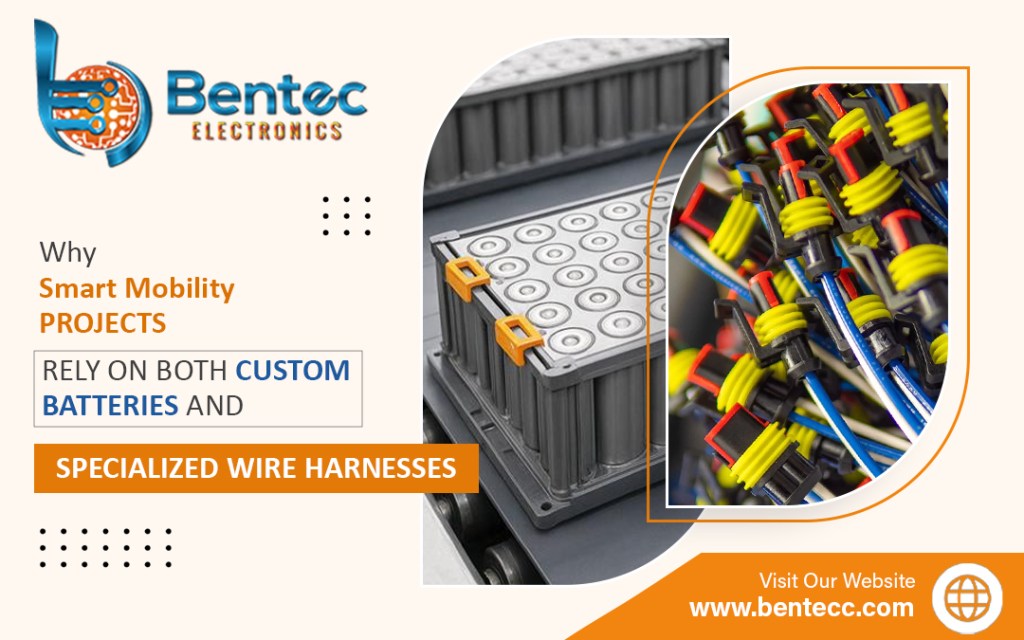
Why Smart Mobility Projects Rely on Both Custom Batteries and Specialized Wire Harnesses

The fast growth of smart mobility solutions has transformed the entire concept of transport. Whether it is electric vehicles (EVs), autonomous, or smart city infrastructure, all such technologies are changing the manner in which we live today. But it is all due to two crucial factors: custom batteries and professional wire harnesses.

These two factors are extremely important in making sure smart mobility projects run well, effectively, and safely. Find out with us why the two are essential in this regard.

The Importance of Custom Batteries to Smart Mobility

Custom battery Singapore solutions are specifically designed according to the unique energy demands of mobility equipment. Compared to off-the-shelf power supplies, a foreign or Singapore custom battery is designed to work within size limitations, weight ratio, and unique performance specifications.

This is important because intelligent mobility equipment differs significantly in power consumption, operating temperatures, and voltage needs. Some of the main benefits of custom batteries in this case include:

  • Maximum energy density: Provides extended run time and level operation.
  • Thermal management capabilities: Prevent overheating with intensive use.
  • Custom shape and weight: Optimal for spatially confined mobility uses.

Power solutions in smart mobility systems have to be efficient as well as resilient. A standard battery falls short in providing the particular discharge rates or lifespans necessary for use in actual operations. Because of this, engineers would often look towards a customized battery Singapore solution provider for these particularized energy needs, where system architecture compatibility and environmental factors are all ensured.

Wire Harnesses: The Unsung Heroes of Connectivity

In contrast to custom batteries, wire harnesses allow the transfer of signals and electricity throughout the vehicle. In smart mobility, with efficiency and miniaturization king, specialized wire harnesses take center stage.

The following is what makes a wire harness manufacturer indispensable in developing smart mobility:

  • Accuracy Engineering: Wire harnesses need to be manufactured to precise lengths, connectors, and tolerances so that there are no performance bottlenecks.
  • Durability and Flexibility: Harnesses need to withstand repeated vibration, environmental exposure, and movement, and need to be constructed and manufactured from tough material.
  • Efficient Routing: Specific harnesses provide efficient use of space, particularly in streamlined, compact intelligent mobility systems.

Wire harnesses also play a major role in bringing together sensors, controllers, and user interfaces—those technologies that make “smart” mobility possible. The selection of the proper wire harness manufacturer makes these assemblies frictionless and enduring.

The Synergistic Need for Both Components

Custom batteries and wire harnesses are complementary parts, not independent ones. The current and voltage provided by the battery must be totally compatible with the capacity of the wire harness. Incompatibility would lead to energy wastage, short circuits, or system failure.

Apart from that, smart components such as GPS, wireless, and AI-powered control systems rely on strong power as well as good data transmission cables—thus, coordination between wire harness engineers and special battery engineers is crucial.

In Conclusion

Future mobility is smart, electric, and networked. In order for this to become a reality, system designers must spend on special-purpose batteries and high-performance wire harnesses. These pieces of equipment, which are usually ignored by end-users, have a direct influence on the efficiency, security, and lifespan of mobility devices.

Whether sourcing a custom battery or a reputable wire harness manufacturing company, precision, compatibility, and reliability have to be the paramount concern in all cases. Only then can smart mobility solutions live up to their dreams of smart, sustainable transport.

The PCB Assembly Process and What You Should Know

A printed circuit board (PCB) is the building block of every single electronic gadget in use today. Whether it’s a digital speedometer in your car, a smart speaker for your house, or a new intelligent thermostat, the PCB is at the core of electronic products. There’s a lot more work involved than merely assembling a bunch of resistors and components to make an electronic device that works.
Accuracy in the PCB assembly process is of the utmost importance. A potential breakdown, ineffectiveness, or even danger can arise from a single slip-up in this area. This article will go over the fundamentals of PCB Assembly Malaysia, including the most crucial procedures.

A General Over view of PCB Assembly

Solder Paste
Applying solder paste is the initial stage in the conventional PCB assembly process. Keep in mind that while this is not necessary for THT, it is for SMT.

Component Placement

Either human hands or machines can accomplish this task (pick-and-place systems) by placing the components on the board using the conventional method of PCB construction. Either human hands or machines can accomplish this task (pick-and-place systems). The meticulous hand-placing of components is a hallmark of THT assembly. Robotic systems place the parts on the board during the SMT process. Keep in mind that both the speed and accuracy of automated placement are comparable to those of human operators.

Reflow
The following step in the conventional PCB Assembly Malaysia is reflow, which entails melting and resolidifying the solder. After passing the board and its components through an oven to melt the solder and establish all the connections, the board is then cooled in a cooler.
You won’t need to reflow solder while using the THT technique. Step two instead involves checking the board and fixing the arrangement of the components. The placement process is done manually, requiring a combination of visual inspection and a design transport frame to ensure accuracy. To ensure accuracy, we use a combination of visual inspection and a design transport frame.
At this stage of the SMT process, we also perform reflow soldering. Before the board goes through a sequence of coolers that progressively lower the temperature, hardening the solder on the board and cementing the components in place, it goes through a furnace, which melts the solder paste and lets it flow as needed.

Inspection
After attaching the components to the board, the next stage in conventional PCB Assembly Malaysia is to visually verify the board and its connections. In the THT and SMT procedures, this phase has already been completed.

Through-Hole Part Insertion
After completing the reflow and inspection steps, operators must manually perform the through-hole insertion using the usual method. Although wave soldering is an option, hand soldering is more common.
Additionally, wave soldering happens during this stage of the THT process. The whole board must pass through cooling after immersion in liquid solder, allowing the solder to solidify.

Final Inspection and Cleaning
In the conventional method of PCB Assembly Malaysia, the last step is to clean the board, components, and solder points to remove any debris or surplus solder and to inspect the board, components, and solder points one last time.

Conclusion
If you’re looking for a Custom battery Singapore manufacturer that can meet your high-mix or low-volume needs at a price you can afford without sacrificing quality, look no further than Bentec Electronics. Full-turnkey design and build, electronics manufacturing, and maintenance services are all part of our service spectrum. We service a wide variety of industries, including electronics, semiconductors, transportation, industrial measurement, and more. A wide variety of systems, including biometrics, transportation, GPS, and semiconductor burn-in boards, are within our area of competence.

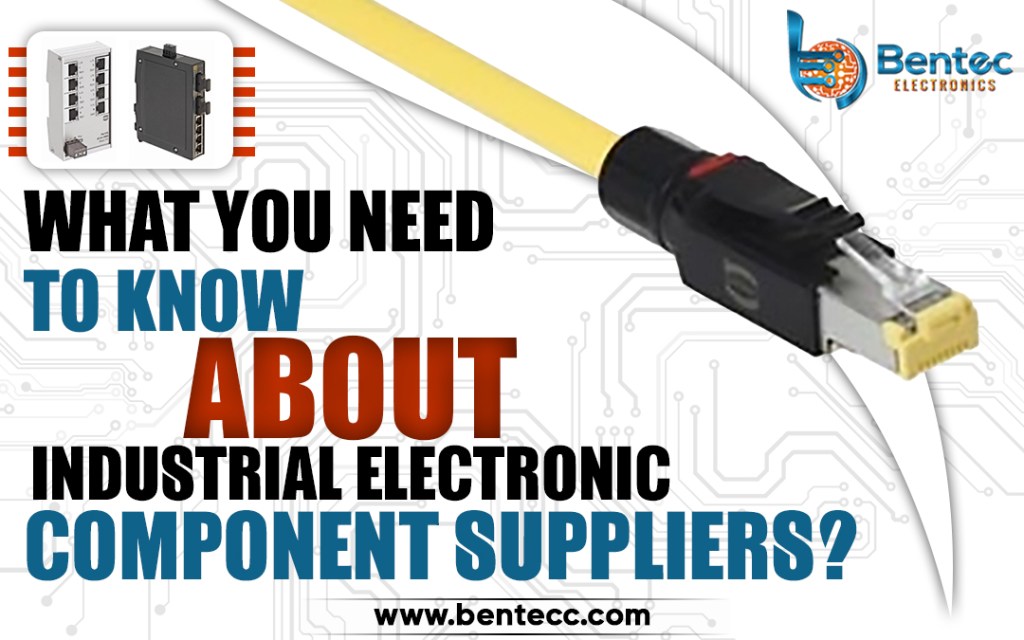
What You Need To Know About Industrial Electronic Component Suppliers?

When it comes to the electronic industry, it is pretty vast and dynamic, from consumer electronics to industrial electronics such as aerospace, and the medical device industry to name a few. That means you would need to know how to find the component for electronic equipment. 

The need for the electronic component can also get dynamic that includes automation components, obsolete components, and hard-to-find components and it can get even further complex. You might need to locate custom battery Singapore suppliers too for certain needs. Here you can find things daunting but you can turn this into an easy affair if you know how to approach it. 

Search for a good electronic component supplier: 

This is something that you should and must do, which means you need to search for references to find good comment suppliers. The right way to do this is to make certain that you are going for references from your industry community or the web forums. 

Through this, you are more likely to find the best electronic component suppliers that can meet your needs. You should approach things objectively so that you find the right solution for your entire electronic component needs, let’s take a look at a few factors. 

Find out about the range of solutions they offer: 

This is the most important thing that you should be looking at while choosing a supplier. You need to find out what industries they cater to such as automation, aerospace, medical device, and other industries. This would help you in finding the component suppliers that can meet your needs easily. 

You would need to ensure that you are looking at the brands they deal with such as Harting, IDEAL, and other global brands. The fact of the matter is that good suppliers will offer you all global brands, which is why it is important to find a good and reputed supplier with a wide range of services and solutions. 

More tips to help you: 

When you are working with the component suppliers, you would need to take a good look at the supply chain management because you would need to get the components delivered to you at the right time. The best suppliers would make sure that they have a good network to get you all the comments delivered globally 

You would need to ensure that you look at the price they charge for components and it would be also intelligent to verify whether they offer you original components or not. You should take a look at how they charge excess management of your inventory, you would get complete solutions from the best suppliers

Order electronic components from the best suppliers:

It is always tricky when you are looking for electronic components from major brands but the points given here should be able to guide you into the right path. All you need to do is to look for the best suppliers using the points mentioned here. 

The right supplier will be able to not only get you good quality components but also get you good service too, the aim should be spotting the best suppliers.