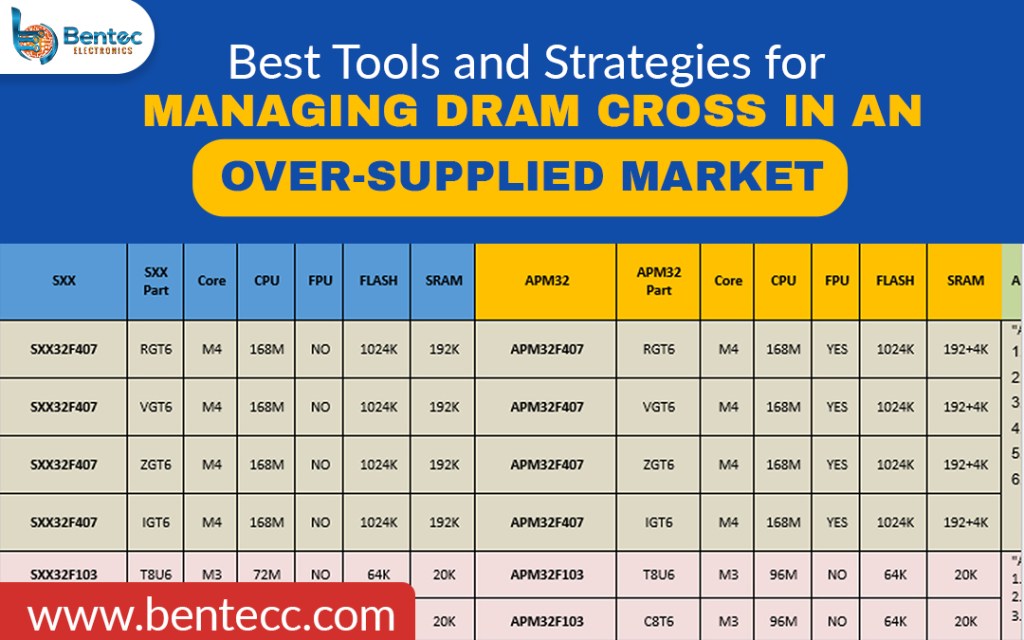
Best Tools and Strategies for Managing DRAM Cross in an Over-supplied Market

Technological advancement can often cause fluctuations in the supply and demand ratios within the semiconductor market. In an oversupplied market, DRAM Cross, where certain DRAM modules are turned around and redeployed for various demands, is a real issue. As with any business, the cost control of DRAM Cross and excess inventory are implicated in achieving strategic goals for profitability and efficient operations.

Here are some of the best practices the industry can use to control DRAM Cross within an over-supplied market better.

Techniques for Efficient DRAM Cross Management

1. Inventory Management Software

Modern Excess Inventory Management systems enable real-time tracking and, at the same time, allow for forecasting. They enable businesses to:

  • Determine possible surplus DRAM modules in the shortest possible time.
  • Synchronize cross-functional reallocation in the supply chain.
  • Develop suggestions to help avoid overstock issues in the business.

2. Data Analytics Platforms

There are numerous resources for highly detailed market analysis and forecasting of fluctuations in demand. These tools are crucial for managing DRAM Cross by:

  • Drawing attention to low demand patterns of delivered modules.
  • Giving recommendations on how some left stock can be used or taken to another market.

3. ERP Systems

Supply chain processes in an organization can be connected and used with coordination by using ERP systems that enhance communication between departments. Key benefits include:

  • Reduced visibility into inventories of memory DRAM.
  • Integration for smooth cross-matching DRAM specifications to new requirements.

4. Market Monitoring Tools

These tools track global pricing trends and regional demand for DRAM, offering insights into the following:

  • Decide the right price levels for products that are available in abundance.
  • Target areas with a more demanding need for the particular kind of DRAM modules.

Appropriate Management Approaches Toward DRAM Cross in Over-Supply Condition

1. Segmentation and Prioritization

Segment inventory using the cutting plane according to the demand, value, and degree of multiproduct use. The high-value DRAM modules should be cross-matched to prevent the firm from incurring losses.

2. Dynamic Pricing Models

It allows for dynamic pricing, which means businesses can increase or decrease their price for extra DRAM modules depending on the market situation. By offering it at lower prices, they purposely make it easier for them to sell excess inventory.

3. Reverse Logistics

With a reverse logistics system in place, business organizations are able to look for means to get value added to the excess stock. This may involve upgrading, redeploying or processing DRAM modules which were no longer useful in their conventional application.

4. Improve Supply Chain Links

This means that businesses enjoy close working relationships with the supply chain, which assists in determining market requirements. These strong relationships are important in enabling the efficient running of various DRAM Cross activities.

5. Leverage Trade-In Programs

With the establishment of trade-in programs, DRAM modules, which are obsolete or once oversupplied in the market, can be returned back to the market, which can give one more chance to extract values and give life to these modules.

Proactive Approach To Excess Inventory Management

Regular control of excess inventory is essential in containing costs, improving the efficiency of operations within an organization and eliminating all risks associated with excess unsold stock in a market. Combining these strategies with robust tools ensures that:

  • Stocks in the pipeline are relatively closer to the market requirements.
  • The excess DRAM modules are either put to proper use or redistributed.
  • Businesses can remain adaptable to the operating environment.

The Bottom Line

In an industry where competition is high, as indicated in the case of DRAM Cross, they will need sophisticated techniques and strategies to implement. Elements like inventory management software, ERP systems, and predictive analysis tools are central to efficient text processing. For operations, measures like segmentation, dynamic pricing, or regional redistribution also help a lot.

Simplifying Excess Inventory Management For You: DRAM Cross and Its Impact

Excess inventory is one of the most critical operational issues that firms in different industries must deal with. In the long run, making unnecessary stocks often causes high costs, low productivity, and wasted resources. There are several ideas to combat such problems, and DRAM Cross is one of the possible solutions, which deals not only with the excess inventory problem but also enhances supply chain performance. 

As a result, this article attempts to discuss DRAM Cross and its contribution towards solving the Excess Inventory Management challenges aligned with the shelter of excess stock.

Reducing the Risks and Techniques of Excess Inventory Management

Information management on excess inventory can be defined as observing and monitoring the excess stock for ultimate distribution for maximum benefit at minimal cost. Overstocking may result from a poor sales forecast, an unpredictable market trend, or a disrupted supply chain. Unless managed correctly, overstocking leads to the following issues:

  • Higher storage costs
  • Outdated materials
  • Cash flow difficulties
  • Environmental degradation from improper disposal

Organizations require complex solutions and strategies to resolve these issues effectively.

Understanding DRAM Cross

It is the process of making choices and utilization of identical memory chips, such as DRAM, on different products or systems. It is a process designed to enhance flexibility in inventory management by:

  • Helping the reuse of various components for another purpose.
  • Allowing various enterprises to put their excess inventory in the correct place to meet the market demand.
  • Saving on the cash tied to inventories since they cycle around faster, reducing wastage.

This cross-referencing system is most helpful in cases of excess electronic parts whose usability becomes short-lived.

DRAM Cross and the Role Played in Excess Inventory Management

1. Improvement in the Efficiency of Resources

DRAM Cross helps organizations effectively manage surplus parts, contributing to the creation of added value from what could become waste. The case suggests that better inventory turnover and utilization of excess inventory can be achieved by finding applications for the spare capacity.

2. Simplified Supply Chain Processes

The method used in our work helps equalize the redistribution of inventory, and we are happy that it can be executed on a number of platforms. With DRAM Cross, the management of your business can be assured that all blockages caused by too much inventory are eliminated, hence keeping the supply chain rolling.

3. Cost Reduction

Stock holding has been a cost factor with high storage costs and depreciation. Some of these costs include the emission of greenhouse gasses, disposal of redundant material, and transportation costs, which DRAM Cross assists in eliminating by offering a platform where the excess material is sold or returned to the manufacturer.

4. Better Forecasting of Inventory

When applied to the management of your inventory, DRAM Cross assists in the modification of your forecasting approaches. When unraveling cross-reference possibilities, you will be able to improve your understanding of demand and component consumption so that more accurate forecasts can be made.

Efficient Execution of DRAM Cross

To get the most out of DRAM Cross for managing excess inventory, follow these steps:

  • Adopt Advanced Tracking Systems: The required cross-referencing and inventory should be properly managed using inventory management software.
  • Collaborate with Partners: Create a good relationship with manufacturers and distributors to look for new market outlets for your excess stock.
  • Monitor Market Trends: It is recommended that the demands of this industry remain updated to understand what kind of surplus inventory is required on the market.

In Conclusion

Successful operation of concern regarding too much inventory is crucial in the current business world. In addition to helping you overcome the problem associated with having too much inventory, which costs financial and logistical resources, DRAM Cross also allows you to create a better future. With DRAM Cross, your business will remain profitable without having to waste so much time in the process.